Deadlifts are an effective way to build strength in your glutes, hamstrings, and back. However, lower back pain after deadlifting is common, particularly when training volume, weight, or technique changes quickly.
Some soreness after a workout can be normal, but persistent or sharp lower back pain may indicate that something needs to be addressed. At Synergy Chiropractic in SE Calgary, we assess the underlying factors contributing to your pain and develop an individualized treatment and rehabilitation plan to help you return to lifting confidently.
Why Does My Lower Back Hurt After Deadlifting?
Deadlifting places significant load on the muscles and joints of the lower back. Pain can occur when the load placed on the tissues exceeds their current capacity. Some common contributors to lower back pain after deadlifting include:
1. Increasing Weight or Training Volume Too Quickly
A sudden increase in weight, repetitions, sets, or training frequency can overload the muscles and tissues around the lower back.
Even if your deadlift technique hasn't changed, your body may not yet be conditioned to handle the increased workload.
2. Technique Changes Under Heavy Loads
Your technique may look good with lighter weights but changes as the weight increases or fatigue sets in.
Common changes can include:
- Excessive movement through the lower back
- Losing tension through the trunk
- The hips rising too quickly
- The bar drifting away from the body
- Rounding or overextending the lower back
- Compensating with the lower back instead of using the hips effectively
There isn't necessarily one "perfect" deadlift position for everyone. Your anatomy, mobility, strength, and experience can all influence how you move.
3. Limited Hip or Ankle Mobility
If your hips or ankles aren't moving well enough for the demands of your particular deadlift setup, your body may compensate elsewhere.
For some people, this can mean increased movement or loading through the lower back.
4. Fatigue
Deadlifting when fatigued can make it more difficult to maintain your usual movement pattern and control.
This can be especially relevant during high-volume workouts or when deadlifts are performed late in a training session.
5. Your Body Isn't Used to the Current Load
Pain doesn't always mean you've "damaged" something.
Sometimes, the tissues around the lower back simply aren't currently prepared for the amount of load being placed on them. Gradually building strength and tolerance can be an important part of recovery.
Is Lower Back Pain After Deadlifting Normal?
Some muscle soreness after deadlifting can be normal, particularly if you've recently changed your training routine or haven't deadlifted for a while.
However, you should pay closer attention to pain that:
- Is sharp or severe
- Gets worse with each workout
- Persists for several days or keeps returning
- Makes normal activities difficult
- Travels into the buttock or leg
- Is accompanied by numbness, tingling, or weakness
- Prevents you from lifting or exercising normally
You don't necessarily need to stop all activity when you experience back pain. In many cases, modifying the activity and gradually returning to loading is more helpful than complete rest.
What Causes Lower Back Pain During a Deadlift?
Pain during a deadlift can have several possible causes, and the location and behavior of your symptoms are important.
For example, pain that occurs primarily when lifting from the floor may have different contributing factors than pain that occurs during lockout.
Your chiropractor can assess:
- Lumbar and thoracic spine movement
- Hip mobility
- Muscle strength and endurance
- Trunk control
- Deadlift movement patterns
- Training volume and recent changes
- Symptoms with different positions and movements
This helps determine what may be contributing to your symptoms rather than simply treating the painful area.
Should I Stop Deadlifting If My Back Hurts?
Not necessarily.
Depending on the severity and nature of your symptoms, you may be able to continue exercising while temporarily modifying your training.
Possible modifications may include:
- Reducing the weight
- Decreasing the number of repetitions
- Taking additional rest between sets
- Temporarily reducing range of motion
- Focusing on controlled technique
- Avoiding movements that significantly aggravate your symptoms
The goal is to find an appropriate level of loading while your back recovers and gradually rebuild capacity.
How Can Chiropractic Care Help With Deadlift Relate Back Pain?
At Synergy Chiropractic, treatment for lower back pain isn't limited to spinal adjustments.
Your care may include a combination of:
Chiropractic adjustments and mobilization
To address areas of restricted movement and help improve mobility.
Soft tissue therapy
To address muscle tension in the surrounding tissues.
Exercise and rehabilitation
To improve strength, control, mobility, and tolerance to loading.
Movement assessment
To identify potential contributors to your symptoms and determine which movements or training modifications may be appropriate.
The treatment approach depends on your symptoms, examination findings, goals, and training demands.
Exercises For Lower Back Pain From Deadlifting
The best exercises depend on what is contributing to your symptoms. However, rehabilitation may involve gradually strengthening the muscles responsible for controlling your spine, pelvis, and hips.
Depending on your presentation, exercises may include:
- Core bracing and trunk endurance exercises
- Glute strengthening
- Hip hinge drills
- Romanian deadlifts with appropriate loading
- Split squats
- Hamstring strengthening
- Loaded carries
- Gradual progression back to conventional deadlifts
The goal isn't simply to strengthen your back. It's to progressively improve your ability to tolerate the movements and loads required for your activities.
When Should I See A Chiropractor For Deadlift-Related Back Pain?
Consider getting assessed if your lower back pain:
- Hasn't improved after several days
- Keeps returning whenever you deadlift
- Is limiting your workouts
- Is affecting work or daily activities
- Is accompanied by symptoms radiating into the buttock or leg
- Is preventing you from returning to your normal training
An assessment can help determine whether you can safely continue training, what modifications may be appropriate, and what rehabilitation may help you return to lifting.
If you experience significant weakness, loss of bowel or bladder control, numbness around the groin/saddle region, or other severe or rapidly worsening neurological symptoms, seek urgent medical assessment.
Low Back Pain From Deadlifting In SE Calgary
If you're experiencing lower back pain after deadlifting, you don't necessarily have to give up strength training.
At Synergy Chiropractic, we work with active individuals who want to reduce their pain while continuing to move and work toward their fitness goals.
Our approach combines chiropractic care, soft tissue therapy, mobility work, strengthening, and individualized rehabilitation based on your assessment.
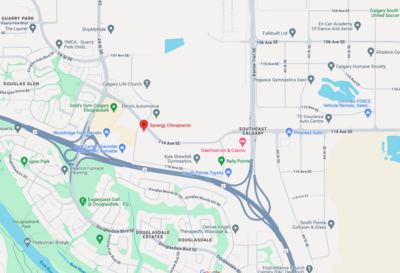
We're conveniently located in SE Calgary near Quarry Park, serving patients from Quarry Park, Douglasdale, Douglas Glen, Riverbend, and surrounding communities.
Ready To Get Back To Lifting?
If your lower back pain is keeping you from deadlifting, exercising, or doing the activities you enjoy, book an assessment at Synergy Chiropractic.
45-minute initial assessments
20-minute follow-up appointments
Direct billing available